Dear all:
Have you ever wanted to saw open the top of a calculator and see where all the numbers live?

Friday, October 22, 2010

Urban Legends

HELLO? ANYBODY THERE?

Annalisa bought a new address book. As she was writing the names from the old book, she noticed her friends name. Linda had died several months ago. She felt silly transferring the name to the new book, but she felt a little strange to just ignore it. She knew she was being a bit morbid, but something was telling her to dial that number. Maybe to know and hear that it didn’t belong to her friend anymore might bring some closure to her. She was having trouble dealing with the grief that was with her almost daily.
Much to her shock, LINDA ANSWERED. Taken aback, she stuttered the beginning of a conversation. In no time, they were talking like the old friends they were. The last several months were especially hard for Annalisa. In addition to losing Linda, her fiancee left her, so she used the opportunity to pour her heart out to Linda. In doing so, the bitterness and hurt she felt lifted from her soul.
Linda asked why Annalisa hadn’t called in so long. "Why hasn’t Bruce Called?" Linda cried. "He promised to always be there for me."
Bruce was the driver of the car that took Linda’s life. He was driving her home after her bridal shower and the shower gifts were packed not only in the trunk but high in the back seat, blocking the back windows. They were to be married in just three short weeks. Bruce was injured in the accident and had been in a deep coma since that day. He knew nothing about Linda’s death.
Annalisa was thrown off guard. How do you answer such a question? Linda continued, "Why haven’t you called all these long months? Why hasn’t Bruce called?" She asked this over and over.
Not knowing what else to say, she gasped "BECAUSE YOU DIED." Annalisa heard no reply. All she heard was the DIAL TONE! Her heart was pounding in her ears, as she hurriedly dialed the number again. "Pizza Hut Pizza" announced the voice on the other end. 
*

What’s it Like in Heaven?

A young couple with a little girl moved into a big old house. The girl appeared to be very happy and to love her new home. One night while she was in bed, she made friends with a little boy named Jack.
The girl’s imaginary friend worried her mother and father and they decided to consult a doctor. The psychiatrist examined the girl and said it was normal for her age.
When they got home they were surprised to find the girl’s toys scattered through the house and the TV turned onto a children's station. The house had been left completely in order.
The parents decided to buy a baby monitor and placed it in their daughter’s room. They overheard the following conversation between their daughter and her friend.
Debbie: "What’s it like in heaven Jack?"
Jack: "I don’t want to tell you. Do you want to play instead?"
debbie: "No, I want to know."
Jack: "OK then, but I can’t tell you, I have to show you"
then they heard a creaking noise
Debbie: "Wow, I can see Granny’s house from here!"
Jack: "Yes, now you have to jump. Go on, I’ll help you. That’s what my Daddy did to me, he helped me find heaven. Do you wanna?"
Debbie’s parents rushed outside where they saw their little girl fall screaming to her death. Her jump was caught on camera. The image showed a mysterious little figure behind her in the window, smiling. 
 *

Thump, Thump, Drag…


It was Friday night and Ashley, a 16 year old girl, was babysitting 2 little boys. The boy’s parents weren’t supposed to come home until very late, so she put them to bed and sat downstairs in the living room to watch some TV. She was flipping channels and came to the evening news. The Anchor-woman reported a warning for her area. She said that a mental patient had escaped from a nearby facility and was on the run from the local authorities. Ashley flipped the channel again to find an old movie she hadn’t seen in a while, but had always enjoyed. By the end of the film, she had forgotten about the news report.
Upstairs one of the boys woke up. He thought he heard a noise coming from the hallway. Thump, thump, draaaag….
The child thought that Ashley must be watching TV, the sound must have been from the program she was watching.
The boy heard the sound again and woke his brother. Together, they listened at the door to the bedroom and the sound kept coming thump, thump, draaaag…thump, thump, drag….
The sound stopped but the boys were still nervous about leaving the safety of their bedroom. They got back into bed and stayed under the covers until their parents got home.
When their parents came in the house they were struck by a gruesome sight. Ashley was laying halfway up the stairs with a trail of blood behind her. Her arms were cut off at the elbows and she’d been climbing the stairs on the bloody stumps of her arms, pulling her badly injured body along to protect the children before she died of blood loss.
Ashley’s attacker was never found! 
*

Check the Back Seat!


A friend stopped at a pay-at-the-pump gas station to get gas. Once she filled her gas tank and after paying at the pump and starting to leave, the voice of the attendant inside came over the speaker. He told her that something happened with her card and that she needed to come inside to pay. The lady was confused because the transaction showed complete and approved. She relayed that to him and was getting ready to leave but the attendant, once again, urged her to come in to pay or there’d be trouble.

She proceeded to go inside and started arguing with the attendant about his threat. He told her to calm down and listen carefully: He said that while she was pumping gas, a guy slipped into the back seat of her car on the other side and the attendant had already called the police. She became frightened and looked out in time to see her car door open and the guy slip out.

Another Version

A woman was driving on her way home when she noticed a big 18 wheeler truck driving behind her. The truck driver flashed his lights at her. She ignored him, but he continued to flash his lights, distracting her from the road. She decided to drive faster to try to move away from the annoying truck. The driver caught up with her car and flashed his headlights at her again.

She called the police on her cell phone and told them what was happening to her. They instructed her to meet them at her house. When she got there she quickly ran out of the car and up to the police officers waiting for her.

Amazingly, the truck stopped in front of her house as well, despite the police cars obviously waiting for him. The officers began to arrest the driver, but he begged them to let him explain. He said that when they were stopped at a rest stop at the same time he saw a man get into the back seat of her car with a huge knife. With no other way to warn her about the man, the driver followed the woman and flashed his lights each time he noticed the man rising up out of the back seat to attack her. The killer ducked back down to avoid being seen.

The police searched the car and arrested the would-be killer instantly.

Another Version

One night a woman went out for drinks with her girlfriends and at the end of the night she left the bar alone. On her way home, her route took her onto a deserted highway. She noticed a lone pair of headlights quickly approaching her car from behind. As the car came closer she noticed that it’s turn signal was on, the car was going to pass.

Just as it moved over to begin passing, suddenly the driver swerved back behind her car, pulled up dangerously close to her tailgate and flashed the high beams at her.

She started getting nervous and kept an eye on the strange vehicle in the rear view mirror. The headlights dimmed for a moment and then the high beams flashed again and the car behind her surged forward. The frightened woman struggled to keep her eyes on the road and fought the urge to keep looking at the car behind her. Finally, she approached her exit but the car continued to follow, flashing the high beams periodically.

Through every stoplight and turn, it followed her until she pulled into her driveway. She figured her only hope was to make a mad dash into the house and call the police. As she flew from the car, so did the driver of the car behind her — and he screamed, “Lock the door and call the police! Call 911!”

When the police arrived the horrible truth was finally revealed to the woman. The man in the car had been trying to save her. As he pulled up behind her and his headlights illuminated her car, he saw the silhouette of a man with a butcher knife rising up from the back seat to stab her, so he flashed his high beams and the figure crouched back down.

The moral of the story: Check the back seat!

In Another Version

When she gets to her house she gets out of the car, runs inside and calls the police. She looks out the window and sees the man get out of the vehicle that followed her with a gun in his hand just as the police arrive. The man protests, “Your arresting the wrong guy, I saw a man get into the back seat of her car with a knife and was going to call the police but didn’t want to let her out of my sight.” Sure enough, when the police looked in the back seat of her car, they found a man with a knife.

Another Version

A girl was traveling to visit a friend and stopped to get gas. When she attempted to return to her car the gas station attendant who had a strong stutter told her to follow him inside as there was a problem with her credit card.

She was suspicious as to why there would be a problem with her card but obliged and went inside. As soon as she walked in, the attendant shut the door behind them and locked it.

The girl started screaming and shouting at him to move out the way. The attendant tried to explain, but his stutter made him difficult to understand. “Th-th-there uh mmm i-i-i-its b-because”

The woman was too scared and too impatient to listen to the attendant. She managed to push him aside and get out of the station, but the attendant was running after her.

She rushed back to her car and got in, slammed the door shut and drove off as the attendant was still trying to get his words out “TH-TH-THERE’S SOMEONE IN THE BACK SEAT!!”

The girl wasn’t listening, but someone rose up behind her in the back seat with an axe and…

Another Version

A young woman is sitting in a coffee house, about ready to leave, when a man approaches her and asks to buy her a cup of coffee. She politely refuses his offer, and tells the man that she’s had enough cups already, and that she’s going to leave. She walks out to her car, and drives away. Following her is the man who was refused on his coffee offer in his truck. She drives along a two-lane stretch of road, and sees the man following her in his truck flashing his lights and honking his horn. The woman is under the assumption that he is angered for her refusal of his offer.

After being followed for around 10 minutes with the man following her still flashing the lights and honking, the woman’s car runs out of gas. The man pulls behind her on the side of the road and gets out of the car with a double-barrel shotgun.

He tells her to get out of the car. She doesn’t at first, then he screams at her “GET OUT OF THE CAR LADY”, and she complies.

He then says “Get out of the car.” again. She tells him she’s already out.

He says “Not you, him”. He gestures to the vehicle and she sees a man wielding a butcher’s knife get out of the back of the car, holding his knife up in a surrendering style. The man tells the woman that he was flashing his lights and honking his horn so the man with the knife wouldn’t harm her.

*

The One That Got Away

A boy and his sister had to stay home alone one night. Their parents were out at a fancy party for their father’s job and they warned the children not to open the door for anyone under any circumstances.
The kids were distracted by TV and weren’t paying attention to their parent’s warning. A couple of hours after the parents left, the children were both in bed asleep when they were woken up by a knock at the door.
The knock came again and they began to think it must be an emergency so the sister went to answer the door.
Her brother lay awake on his bed, listening for her to come back to her room – but he didn’t hear her return. He got nervous and decided to leave and wait for his parents to get home at the neighbor’s house. He got out of bed and headed out the back door, down the side of the house and across his neighbor’s lawn.
They told him they were glad to see him because they had just heard on the news that there was an escaped murderer on the loose and he was last seen just a few blocks away.
When his parent’s came home much later that night, they found his sister’s body dead by the front door and a discarded knife on the brother’s bed. 
*

Frightened and Fearless

There are two girls; Sandra who is totally fearless and Marie who gets frightened when you tap her on the shoulder.
Though they are very different, they are good friends and Marie has agreed to spend the night at the Sandra’s house for one full weekend. Though Sandra loves to watch horror movies, Marie is too scared to watch them with her so they decide to tell each other ghost stories. Sandra is the expert on any type of frightening story and she really wants to scare Marie. She tells her stories of babysitters hacked to death, children eaten alive and all sorts of terrible happenings.
After some time, many stories and lots of drinks and snacks, Sandra has to pee and excuses herself to the bathroom. Minutes pass and all Marie could think of are all the stories she had just heard. She feels like Sandra has been taking a long time in the bathroom and when she listens and doesn’t here running water she begins to worry.
Suddenly she realizes that Sandra must be playing a joke on her so Marie decides to wait her out. While she waits, the phone rings and she jumps. She realizes that she’s been holding her breath and her hands are closed into tight fists. She tries to shake herself to calm down, telling herself that everything is fine. Why is she letting Sandra to freak her out like this? The phone continues to ring and since she thinks that Sandra doesn’t want to spoil her joke by answering the phone, Marie reaches to pick up the receiver. "Hello?" she says nervously. All she can hear is breathing on the other end of the line and then a “click”.
Marie can feel herself beginning to panic. She climbs into Sandra’s bed and pulls the covers over her head. Finally she hears scuffling of feet and she thinks they are Sandra’s but the sound passes by the door and does not pause. Marie is too frightened to call out Sandra’s name and eventually she hears the feet again but this time they seem very far away. Suddenly a scream rips through the house.
The whole house is dark except for Sandra’s room but Marie is so shaken that she decides she’s got to go find her friend. She leaves the bedroom and begins to inch down the hallway, still praying that this was some giant hoax and Sandra would jump out and tickle her and they would laugh and it would all be over. Finally she turned a corner and saw Sandra sitting at the end of the hall, leaning against the wall. Marie sighed. The fear was gone. She knew it was just Sandra messing with her head.
She found a light switch and flicked it on. To her horror the light revealed Sandra, covered in blood, her eyes were gouged out, and her stomach ripped open. Marie let out a terrified scream as she read the words painted in Sandra’s own blood over her mutilated corpse. "She became her own Urban Legend".
*

Fun House Replacement


Brian was crazy about the carnival. He went to see it every summer it came to his town and he had never missed a year. He knew every ride and attraction by heart: the Ferris wheel, the gypsy fortune teller, the shooting gallery, throw a dart and get a poster game, even the freak show – but Brian’s favorite attraction was the funhouse.
He could always spot it from the midway: a black building that looked like a clutter of giant shoe boxes of different sizes lying end to end. The weather-beaten, black exterior was decorated with garish drawings of victims being chased by all sorts of creatures into the mouth of hell. There was a drawing of a graveyard, populated by rotting corpses and other demons of darkness feasting on the rotting remains of the freshly dead. The monsters were painted in slashes of bright red, green, and orange that seemed to glow brighter than any of the midway lights. The people being chased away looked like they were screaming in horror. Brian imagined himself to be one of those people. He remembered the layout of the funhouse, and it committed to memory for some time, but this year he noticed something new had been added.
The end of the funhouse walk was lit by a solitary overhead strobe light bulb. As he approached, Brian had spied a flutter of movement near the bulb. He had nearly reached the hall’s end when he heard a loud creak, and something bulky dropped down from the ceiling. The light flared bright with shocking intensity and Brian found himself standing face to face with a corpse dangling from the end of a noose. Hands slack at the sides suddenly reached up to grab him. AWESOME! Brian thought that he might be able to convince some friends to come and see the thing before he remembered that tonight was the last night of the carnival.
At first he was disappointed, but then he thought about how cool it would be to actually steal the corpse. He could just imagine the looks on his friend’s faces when they walked into his bedroom and saw a corpse hanging from the inside of his door! WICKED! Brian was scheming so hard that he didn’t look where he was going on his way out and nearly tumbled over the man who ran the funhouse. The guy was a freak too with misshapen muscular limbs and a hump in his back that threw his whole posture out of alignment. The gargoyle-faced guy fixed him with an evil look. Brain had never saw this man before. He was as new as the corpse in the funhouse-and about as ugly! From the look the guy gave him, it seemed as though he knew that Brian was thinking he belonged inside with the rest of the horrors. Brian felt a tingle of fear until the creep turned back to taking tickets from the next group of funhouse victims.
Brian walked the fairgrounds for a few hours, killing time while he waited for the carnival to close. All the while, his thoughts were on the funhouse and how he might steal the dummy. At midnight, a voice came over the public speaker system telling the crowd that the carnival was closing down, and to please start heading home. Now was his chance. When he’d left the funhouse, he’d seen the back door: just a loosely hanging piece of black canvas. It would be a cinch to sneak inside during the confusion of everyone leaving the fairgrounds. He could have the dummy in his hands in a few minutes and take it out through the front gates with him. Lots of other people were carrying huge stuffed animals, and no one would suspect that the dummy wasn’t something he’d won at one of the games. The freaky creep that ran the funhouse probably wouldn’t know that his dummy was missing until they set up in the next town, and then it would be too late for them to come back looking for it.
By the time Brian reached the funhouse, the lights shining on the painted front were all off, and the gangplank leading up to it had chains across it. Brian made sure no one was looking, then ducked under the wires put up to keep people from straying off the path in front. With the lights off, it was darker in back than he had thought it would be. The back door to the funhouse beckoned, and Brian was surprised to discover that it was completely open. All he had to do was slip behind the flap and he was in. It was like they were begging someone to come in and rip them off. It took a moment for his eyes to adjust to the dim light inside. He felt his way through along the walls, but the weird angles made him uncertain of where he was. He was feeling his way along the wall when something smacked him across the face. It was hairy and smelled disgusting as it pressed against his mouth. He spluttered and gagged against it. With a laugh, he realized it was a fake arm that had shot out of the wall. He remembered how he had dodged it during his earlier walk through. Brian felt a floorboard wobble beneath his shoe, and when he lifted his foot from it the arm pulled back. It was on some kind of spring that the funhouse visitor activated by stepping on the floor. That was probably the way all the funhouse frights worked.
A dim red light was shining down on the hung corpse as Brian groped his way to it. They hadn’t even bothered to hoist it back up after the last show. Brian reasoned that they probably just left it there so that it would be easier for the freak to take it apart when they packed up the carnival the next day. He twisted the dummy around and saw it was locked into a harness with struts that extended into the arms. So that was how they made the arms seem like they were clutching at you as it bounced at the end of the rope. All Brain had to do was lift the dummy up to free the harness from the hook that attached it to the rope.
Creaaaaaaaakkkkk! A floorboard sounded behind Brain. He instantly turned to stone. Creaaaaaaaakkkkk! There it was again. He thought about running back the way he had come. But he’d already put so much effort into getting this far, it would be a shame not to follow through. Creaaaaaaaakkkkk! It was only his nerves he thought. He was only scaring himself. There were probably lots of loose floorboards in the rickety building that were making the noise. The funhouse had scary things in it-but nothing real. Brian turned around and embraced the hanging corpse, his hands clasping just behind the harness. The thing’s bobbing head nodded down and its face rested against his cheek. He felt the icy coldness of a solid black plastic mask. The shiny surface reflected light in strange ways so that it would look like it was grinning or snarling back at you. Up close, he also realized the dummy had a rotting, musty smell to it. The hook didn’t give easily, and Brian lost patience. He gave it a sharp tug. The dummy slipped out of his clumsy hands, and as he went to grab it he awkwardly pulled on one of the arms. He heard a ripping sound and felt it wrench free of its socket.
Brian got upset after he found that he broke the dummy. The detached arm slithered out of the sleeve while the hand still snug in Brian’s grasp. It had a knob-like bump protruding from its end, and Brian held it up to the strobe light to get a better look. He dropped it as though it were red hot. IT WAS A BONE! A REAL HUMAN BONE! The dummy spun around and Brian hesitantly reached up and flipped off the plastic mask. The face behind it was mummified with gray skin the texture of leather stretched over its face in an expression of pure terror and a filthy gag tied around its mouth. Its skin was dried out and the eyes were sunken in. Brian removed the corpse’s gag and could make out its decayed, but human skeletal teeth in the gaping mouth. THIS WAS NO DUMMY!
Brian stepped back, gagging. A pair of hands reached out from the wall behind him and grabbed him! He stepped off the board, trying to make them retract and let go of him, but no matter how his feet danced over the floorboards surface, the arms held tight. Then one of them grabbed him by the hair and roughly spun him around. Staring back at Brian was the leering face of the freaky creep that ran the funhouse! The man smiled at him wickedly, and laughed. Then he brought down something hard painfully on Brian’s skull.
When he finally came to, he found that he could not move his limbs. They were bound to something hard and unyielding. His chest felt constricted, as though there were cords wrapped around it, attaching to something behind him. He realized there was a nasty tasting piece of cloth stretched around his mouth, making it difficult for him to make any noise. Brian felt himself twirled around and came face-to-face with the funhouse creep. The man stared back at him and stroked his face with the dirty fingernails of his hand.
"Such a good-looking boy, much better looking than that overused bag of bones that you desecrated, but too childish for your own good." Said the freak.
Brian tried to scream but could muster no more than a gurgle against the wadded cloth in his mouth. He flailed his legs, only to find that he was no longer standing on the creaking floorboards of the funhouse but was instead, several feet above them. The freaky creep tugged Brian’s head roughly, forcing him to look down at the shriveled remains of the real funhouse corpse, lying on the floor. What a shame Brian was such a mischievous boy and how sad that he’d gone poking into things he shouldn’t have, just like the last mischievous boy that the freaky creep took care of. Now Brian would have to replace what he had broken. The freak snapped something over Brian’s face. Something dark and tight. Something cold and plastic that would hide his tears.
When Brian awoke again to the sounds of creaking floorboards, pure terror overtook him as he realized that the sounds came from a group of funhouse visitors. He dreaded their footsteps as they came closer and closer. He tried to struggle, he tried to scream. Suddenly, Brian heard a quick clicking sound that released a spring. Then, Brain felt the support he was standing on give way and he plummeted into complete darkness. Brian’s disappearance was a complete mystery to his family and friends. Eventually they gave up the search for him, and assumed he ran away with the carnival. 
*

Don’t Look Back
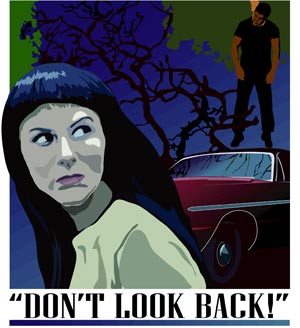

On the foggy night of their senior costume party Nicole and her date Mark were driving to their school in Mark’s old 1987 Toyota. They heard a special news report “…warning everyone the convicted killer, Owen the HangMan Helms, has escaped from the near-by criminal asylum he was last seen in a woods by Pinecrest…”
Nicole started freaking out “That’s just on the other side of the valley! Mark turn the car around I want to go home” but just then the car bucked twice then died. An overhanging tree branch went THUNK… THUNK… THUNK… on the roof of the car and Nicole jumped. “It’s fine. I’m going to look for help” said Mark, “climb in the back and cover yourself up in that blanket. When I come back I’ll knock on the roof 3 times. If you hear more or less than 3 knocks DONT OPEN IT UP.”
Nicole tried to persuade him not to go but Mark said “What are we going to do? We can’t just sit here until someone drives by.” and so he left.


Nicole locked the car doors and climbed into the back seat and covered herself up in the blanket and waited. She looked at her watch 25 minutes had passed… 35… 40 then she heard a knock… “oh come on two more” knock… “yes! mark just one more” knock… “ok! stop no more mark please let that be you!” knock… “NO!” her blood turned ice cold knock… knock… knock… “please someone! please! someone help me!” she prayed she thought it might be the Hangman trying to torment her… did he know she was inside?

Then the knocking stopped. She could hear a radio, with a dispatcher’s voice giving instructions that she couldn’t make out. Two men were staring at her through the window. Nicole realized they were police, behind them she saw the spinning blue and red lights of the police car, “It’s ok young lady. You can come out now” said the 1st police officer.

Nicole’s shaking hand finally found the lock and she stumbled out. “Where’s Mark? Didn’t he come with you?” Nicole asked.

“Come to the patrol car. DONT LOOK BACK – just keep your eyes straight ahead” said the 2nd police officer.

“Why can’t I look back?” she asked.

“Just come on to the patrol car miss” said the police men.

Then Nicole looked behind her and saw Mark, still in his gray-jogging outfit, hanging from an overhead tree branch. One of his Nike shoes was gently hitting the roof of the car, knock… knock… knock…

Another Version

The story is the same up until he leaves the car. He tells his girlfriend to lock the doors and don’t open them until he taps on the roof three times. He leaves and she does what he says and was for him to come back.
About an hour goes by and she starts to get worried when she hears tapping on the roof. After three times she is about to open the door, but the tapping doesn’t stop. Confused and frightened she doesn’t open the door at all and sits in there for hours, the whole time hearing the tapping on the roof.

Finally the police arrived and a cop came to the car and told her to get out, to come with him and not to look back. Of course she does looks back to find her boyfriend hanging from a tree over the car. The wind caused the branch to rock making his feet tap the car over and over.

Another Version

Just outside of the city of Syracuse, NY there is a hamlet that was once shown on the map as Cedarvale, NY (sometimes you will still see it listed). The main road through this area is Cedarvale Road. Part of this road is very curvy, and in fact is called the 13 Curves which it actually has. Curve number 7 (either way) is called Dead Man’s Curve.

According to the local legend, many years ago (likely in the 20′s or 30′s) a newlywed couple was driving down this road, on their way to a friend’s house on Otisco Lake from their wedding reception.as they started to round Dead Man’s Curve, the car stalled. The new husband, being the chivalrous type, told his new bride to wait in the car while he walked on down the road to the local post office/general store to ask for help.

The Bride waited in the car and dozed off for a little bit. When she woke up, it was dark, and she could not figure out what woke her up. Then she heard a scratching on the roof of the car. She wanted to know what was scratching the roof, but was afraid to get out of the car alone at night. At some point, she managed to doze back off and was awakened in the morning by the police tapping on the window. They escorted her out of the car not saying much of anything, and while they were leading her away, she turned around to look back, and saw her husband, hanging by his neck by a rope over the limb of the tree they had parked under.

As the story goes, she had a complete breakdown at this point and spent the next few years in the local asylum, until she died, some say, of a broken heart and broken mind. A few years later, a local farmer driving through the area saw a woman standing on the side of the road at the seventh curve of the 13 curves. She was wearing a wedding dress. When he stopped to ask if she needed help, she just vanished. People report seeing the Woman in White on dead man’s curve to this very day.

*

The Message Under the Stamp


During the war a soldier faithfully wrote his mother every week so she would know he was all right. One week she didn’t get a letter and immediately began to worry.
A couple of weeks later, she got a letter from the Army saying that her son had been captured and was being held in a Prisoner-of-War camp. They assured her that they had no reason to believe the American prisoners were being mistreated in any way.
A few weeks later the woman finally received another letter from her son, it read: "Dear Mom, Try not to worry about me, they are treating us well and I’ll be released as soon as the war is over. Make sure that little Teddy gets the stamp for his collection. Love you, Joe"
The woman was overjoyed to hear the news, but was confused because she had no idea who "little Teddy" was. She decided to steam the stamp from the envelope and have a look. When she did she saw that written on the back of the stamp were the words:
"They’ve cut off my legs".
*

Reflection


One cold winter night, sixteen year old Katie was home alone. Her parents had gone out to a dinner party. It had been snowing all that afternoon, but had just recently stopped. After studying for a few hours she decided to relax a little. She made some popcorn, got a nice thick blanket and laid back on the couch to watch some TV in the living room. The television was positioned in front of one side of the glass sliding door that lead to a patio and the back yard. By midnight Katie’s parents still hadn’t come home and she was gripped with fear because from the corner of her eye she could have sworn she caught a glimpse of a very strange looking man staring at her standing outside the glass door behind the television. Terrified, she panicked, pulled blanket up over her head and grabbed the cordless phone that was by her side.

Katie called the police and, as luck would have it, there was a patrol car not far from her house. In a few minutes police are on the scene and Katie told them about the strange man who was standing outside, staring in through the glass.

The police opened the glass sliding door and looked around. After a few moments they turned around and explained to her that there could not have been anyone standing out there, as there would be footprints in the snow. The cops tell her that she is probably just tired and her imagination had got the better of her. Katie began to feel relieved, but still a little shaken. As the police officers are about to leave, one of them stopped and looked behind the couch Katie was sitting on. His jaw dropped and skin went pale. Katie noticed the man’s reaction and jumped up to look too. She saw what made the officer react that way. There were wet footprints on the carpet behind the couch. She hadn’t seen the man outside the door, she’d seen his reflection when he was standing behind her.

*

Babysitting is a Dangerous Job


A young couple went out to dinner one evening and left the babysitter in charge of their two children. The children had been put to bed and the babysitter was watching the television when the phone rang. She answered but all she heard was a man laughing hysterically and then a voice saying, "I’m upstairs with the children, you’d better come up." Thinking it was "one of those prank phone calls" or a practical joke she slammed down the receiver and turned the television sound up.
A short time later the phone rang again and, as she picked it up, the unmistakable hysterical laughter came down the line and the voice once again said "I’m upstairs with the children, you’d better come up." Getting rather frightened she called the operator and was advised they would notify the police and, should he phone again, could she keep him talking in order to give them time to trace the call and have him arrested.
Minutes after she replaced the receiver the phone rang again and, when the voice said, "I’m upstairs with the children, you’d better come up," she tried to keep him talking. However, he must have guessed what she was trying to do and he put the phone down.
Only seconds later the phone rang again, this time it was the operator who said, "Get out of the house straight away, the man is on the extension." The babysitter put down the phone and just then heard someone coming down the stairs. She fled from the house and ran straight into the arms of the police. They burst into the house and found a man brandishing a large butcher’s knife. He had entered the house through an upstairs window, murdered both the children and was just about to do the same to the poor babysitter. 
*
A man and wife were driving late one night when they were flagged down by a woman that appeared to be hurt. She claimed she'd been in an accident and her baby was alive but trapped in the car. The man told her to wait with his wife and he'd see what he could do. He got to the car and found a couple obviously dead in the front seat but a baby crying in a carseat. He cut the baby loose and returned to his own car.
When he got there his wife was alone, he asked her where the woman had went and she replied that she'd followed him to the wreck. He left the baby with his wife and went back to the car to find her. When he got there he realized the woman who'd been instantly killed in the front seat had been the one who'd flagged him down.

*

Monday, October 11, 2010

EVP -- Electric Voice Phenomenon

There's a tool that ghost hunters and enthusiasts use to try to communicate to the dead/spirits that may walk around us. Basically, there are several ways to go about using this tool -- which is called EVP -- and the most recent way to go about this form of communication is to use a digital recorder. The "hunter" will ask a question (i.e. is there anyone here who wishes to communicate with us?) and wait about 15 to 30 seconds before asking the next question. In theory, in that space, the ghost will answer the question should they want to communicate. Likewise, in theory, the ghost in able to be heard in the white noise -- or static -- of the recorder. Some EVPs are hard to make out and some aren't. That's why they're classified into different categories. 'A' is the best meaning that it's clear and easily made out. These recordings aren't seen too often. 'B' means that most of the words are clear and there's only one or two that you have to guess on. 'C' is the hardest to make out what is being said.

Following are some copies of EVPs. Some of them may very well be faked -- since I wasn't there, it's hard to tell if that's the case. I'll try to post some from shows like Ghost Hunters, Ghost Adventures, and Paranormal State.

This one is from the Central New York Ghost Hunters:


This is from Ghost Adventures from the Travel Channel. These are some of the best moments.


This is one of my favorites from Ghost Adventures. This is one of their first cases that they did. The last half of it is pretty creepy.


This is from the show Paranormal State.


Saturday, October 9, 2010

Today's Creepy Story

The Cask of Amontillado

Edgar Allan Poe


THE thousand injuries of Fortunato I had borne as I best could, but when he ventured upon insult, I vowed revenge. You, who so well know the nature of my soul, will not suppose, however, that I gave utterance to a threat. AT LENGTH I would be avenged; this was a point definitively settled -- but the very definitiveness with which it was resolved precluded the idea of risk. I must not only punish, but punish with impunity. A wrong is unredressed when retribution overtakes its redresser. It is equally unredressed when the avenger fails to make himself felt as such to him who has done the wrong.

It must be understood that neither by word nor deed had I given Fortunato cause to doubt my good will. I continued as was my wont, to smile in his face, and he did not perceive that my smile NOW was at the thought of his immolation.

He had a weak point -- this Fortunato -- although in other regards he was a man to be respected and even feared. He prided himself on his connoisseurship in wine. Few Italians have the true virtuoso spirit. For the most part their enthusiasm is adopted to suit the time and opportunity to practise imposture upon the British and Austrian MILLIONAIRES. In painting and gemmary, Fortunato, like his countrymen , was a quack, but in the matter of old wines he was sincere. In this respect I did not differ from him materially; I was skilful in the Italian vintages myself, and bought largely whenever I could.

It was about dusk, one evening during the supreme madness of the carnival season, that I encountered my friend. He accosted me with excessive warmth, for he had been drinking much. The man wore motley. He had on a tight-fitting parti-striped dress and his head was surmounted by the conical cap and bells. I was so pleased to see him, that I thought I should never have done wringing his hand.

I said to him -- "My dear Fortunato, you are luckily met. How remarkably well you are looking to-day! But I have received a pipe of what passes for Amontillado, and I have my doubts."


"How?" said he, "Amontillado? A pipe? Impossible ? And in the middle of the carnival?"

"I have my doubts," I replied; "and I was silly enough to pay the full Amontillado price without consulting you in the matter. You were not to be found, and I was fearful of losing a bargain."

"Amontillado!"

"I have my doubts."

"Amontillado!"

"And I must satisfy them."

"Amontillado!"

"As you are engaged, I am on my way to Luchesi. If any one has a critical turn, it is he. He will tell me" --

"Luchesi cannot tell Amontillado from Sherry."

"And yet some fools will have it that his taste is a match for your own."

"Come let us go."

"Whither?"

"To your vaults."

"My friend, no; I will not impose upon your good nature. I perceive you have an engagement Luchesi" --

"I have no engagement; come."

"My friend, no. It is not the engagement, but the severe cold with which I perceive you are afflicted . The vaults are insufferably damp. They are encrusted with nitre."

"Let us go, nevertheless. The cold is merely nothing. Amontillado! You have been imposed upon; and as for Luchesi, he cannot distinguish Sherry from Amontillado."

Thus speaking, Fortunato possessed himself of my arm. Putting on a mask of black silk and drawing a roquelaire closely about my person, I suffered him to hurry me to my palazzo.

There were no attendants at home; they had absconded to make merry in honour of the time. I had told them that I should not return until the morning and had given them explicit orders not to stir from the house. These orders were sufficient, I well knew, to insure their immediate disappearance , one and all, as soon as my back was turned.

I took from their sconces two flambeaux, and giving one to Fortunato bowed him through several suites of rooms to the archway that led into the vaults. I passed down a long and winding staircase, requesting him to be cautious as he followed. We came at length to the foot of the descent, and stood together on the damp ground of the catacombs of the Montresors.

The gait of my friend was unsteady, and the bells upon his cap jingled as he strode.

"The pipe," said he.

"It is farther on," said I; "but observe the white webwork which gleams from these cavern walls."


He turned towards me and looked into my eyes with two filmy orbs that distilled the rheum of intoxication .

"Nitre?" he asked, at length

"Nitre," I replied. "How long have you had that cough!"

"Ugh! ugh! ugh! -- ugh! ugh! ugh! -- ugh! ugh! ugh! -- ugh! ugh! ugh! -- ugh! ugh! ugh!

My poor friend found it impossible to reply for many minutes.

"It is nothing," he said, at last.

"Come," I said, with decision, we will go back; your health is precious. You are rich, respected, admired, beloved; you are happy as once I was. You are a man to be missed. For me it is no matter. We will go back; you will be ill and I cannot be responsible. Besides, there is Luchesi" --

"Enough," he said; "the cough is a mere nothing; it will not kill me. I shall not die of a cough."

"True -- true," I replied; "and, indeed, I had no intention of alarming you unnecessarily -- but you should use all proper caution. A draught of this Medoc will defend us from the damps."

Here I knocked off the neck of a bottle which I drew from a long row of its fellows that lay upon the mould.


"Drink," I said, presenting him the wine.

He raised it to his lips with a leer. He paused and nodded to me familiarly, while his bells jingled.

"I drink," he said, "to the buried that repose around us."

"And I to your long life."

He again took my arm and we proceeded.

"These vaults," he said, are extensive."

"The Montresors," I replied, "were a great numerous family."


"I forget your arms."

"A huge human foot d'or, in a field azure; the foot crushes a serpent rampant whose fangs are imbedded in the heel."

"And the motto?"

"Nemo me impune lacessit."

"Good!" he said.

The wine sparkled in his eyes and the bells jingled. My own fancy grew warm with the Medoc. We had passed through walls of piled bones, with casks and puncheons intermingling, into the inmost recesses of the catacombs. I paused again, and this time I made bold to seize Fortunato by an arm above the elbow.

"The nitre!" I said: see it increases. It hangs like moss upon the vaults. We are below the river's bed. The drops of moisture trickle among the bones. Come, we will go back ere it is too late. Your cough" --

"It is nothing" he said; "let us go on. But first, another draught of the Medoc."

I broke and reached him a flagon of De Grave. He emptied it at a breath. His eyes flashed with a fierce light. He laughed and threw the bottle upwards with a gesticulation I did not understand.

I looked at him in surprise. He repeated the movement -- a grotesque one.

"You do not comprehend?" he said.

"Not I," I replied.

"Then you are not of the brotherhood."

"How?"

"You are not of the masons."

"Yes, yes," I said "yes! yes."

"You? Impossible! A mason?"

"A mason," I replied.

"A sign," he said.

"It is this," I answered, producing a trowel from beneath the folds of my roquelaire.


"You jest," he exclaimed, recoiling a few paces. "But let us proceed to the Amontillado."

"Be it so," I said, replacing the tool beneath the cloak, and again offering him my arm. He leaned upon it heavily. We continued our route in search of the Amontillado. We passed through a range of low arches, descended, passed on, and descending again, arrived at a deep crypt, in which the foulness of the air caused our flambeaux rather to glow than flame.

At the most remote end of the crypt there appeared another less spacious. Its walls had been lined with human remains piled to the vault overhead , in the fashion of the great catacombs of Paris. Three sides of this interior crypt were still ornamented in this manner. From the fourth the bones had been thrown down, and lay promiscuously upon the earth, forming at one point a mound of some size. Within the wall thus exposed by the displacing of the bones, we perceived a still interior recess, in depth about four feet, in width three, in height six or seven. It seemed to have been constructed for no especial use in itself, but formed merely the interval between two of the colossal supports of the roof of the catacombs, and was backed by one of their circumscribing walls of solid granite.

It was in vain that Fortunato, uplifting his dull torch, endeavoured to pry into the depths of the recess. Its termination the feeble light did not enable us to see.

"Proceed," I said; "herein is the Amontillado. As for Luchesi" --

"He is an ignoramus," interrupted my friend, as he stepped unsteadily forward, while I followed immediately at his heels. In an instant he had reached the extremity of the niche, and finding his progress arrested by the rock, stood stupidly bewildered . A moment more and I had fettered him to the granite. In its surface were two iron staples, distant from each other about two feet, horizontally. From one of these depended a short chain. from the other a padlock. Throwing the links about his waist, it was but the work of a few seconds to secure it. He was too much astounded to resist . Withdrawing the key I stepped back from the recess.


"Pass your hand," I said, "over the wall; you cannot help feeling the nitre. Indeed it is VERY damp. Once more let me IMPLORE you to return. No? Then I must positively leave you. But I must first render you all the little attentions in my power."

"The Amontillado!" ejaculated my friend, not yet recovered from his astonishment.

"True," I replied; "the Amontillado."

As I said these words I busied myself among the pile of bones of which I have before spoken. Throwing them aside, I soon uncovered a quantity of building stone and mortar. With these materials and with the aid of my trowel, I began vigorously to wall up the entrance of the niche.

I had scarcely laid the first tier of my masonry when I discovered that the intoxication of Fortunato had in a great measure worn off. The earliest indication I had of this was a low moaning cry from the depth of the recess. It was NOT the cry of a drunken man. There was then a long and obstinate silence. I laid the second tier, and the third, and the fourth; and then I heard the furious vibrations of the chain. The noise lasted for several minutes, during which, that I might hearken to it with the more satisfaction, I ceased my labours and sat down upon the bones. When at last the clanking subsided , I resumed the trowel, and finished without interruption the fifth, the sixth, and the seventh tier. The wall was now nearly upon a level with my breast. I again paused, and holding the flambeaux over the mason-work, threw a few feeble rays upon the figure within.

A succession of loud and shrill screams, bursting suddenly from the throat of the chained form, seemed to thrust me violently back. For a brief moment I hesitated -- I trembled. Unsheathing my rapier, I began to grope with it about the recess; but the thought of an instant reassured me. I placed my hand upon the solid fabric of the catacombs , and felt satisfied. I reapproached the wall. I replied to the yells of him who clamoured. I reechoed -- I aided -- I surpassed them in volume and in strength. I did this, and the clamourer grew still.

It was now midnight, and my task was drawing to a close. I had completed the eighth, the ninth, and the tenth tier. I had finished a portion of the last and the eleventh; there remained but a single stone to be fitted and plastered in. I struggled with its weight; I placed it partially in its destined position. But now there came from out the niche a low laugh that erected the hairs upon my head. It was succeeded by a sad voice, which I had difficulty in recognising as that of the noble Fortunato. The voice said --

"Ha! ha! ha! -- he! he! -- a very good joke indeed -- an excellent jest. We will have many a rich laugh about it at the palazzo -- he! he! he! -- over our wine -- he! he! he!"

"The Amontillado!" I said.

"He! he! he! -- he! he! he! -- yes, the Amontillado . But is it not getting late? Will not they be awaiting us at the palazzo, the Lady Fortunato and the rest? Let us be gone."

"Yes," I said "let us be gone."

"FOR THE LOVE OF GOD, MONTRESOR!"

"Yes," I said, "for the love of God!"

But to these words I hearkened in vain for a reply. I grew impatient. I called aloud --

"Fortunato!"

No answer. I called again --

"Fortunato!"

No answer still. I thrust a torch through the remaining aperture and let it fall within. There came forth in return only a jingling of the bells. My heart grew sick -- on account of the dampness of the catacombs. I hastened to make an end of my labour. I forced the last stone into its position; I plastered it up. Against the new masonry I reerected the old rampart of bones. For the half of a century no mortal has disturbed them.


In pace requiescat!

Friday, October 8, 2010

October: It's Not Just for Trick-or-Treat

October isn't just for Halloween, costumes, parties, and candy. October is also Breast Cancer Awareness Month. Following are some interesting facts about breast cancer. Remember: please do a self exam every month, and have regular mammograms as directed by your doctor. If you feel anything unusual, don't hesitate to get it checked out; early detection can save lives! 

Breast cancer is the most common cancer in women in the United States, aside from skin cancer. According to the American Cancer Society (ACS), an estimated 192,370 new cases of invasive breast cancer are expected to be diagnosed among women in the United States this year. An estimated 40,170 women are expected to die from the disease in 2009 alone. Today, there are about 2.5 million breast cancer survivors living in the United States.

If you're worried about developing breast cancer, or if you know someone who has been diagnosed with the disease, one way to deal with your concerns is to get as much information as possible. In this section you'll find important background information about what breast cancer is and how it develops.

Breast cancer is a malignant tumor that grows in one or both of the breasts. Breast cancer usually develops in the ducts or lobules, also known as the milk-producing areas of the breast.

Breast cancer is the second leading cause of cancer death in women (after lung cancer). Although African-American women have a slightly lower incidence of breast cancer after age 40 than Caucasian women, they have a slightly higher incidence rate of breast cancer before age 40. However, African-American women are more likely to die from breast cancer at every age. Breast cancer is much less common in males; by comparison, the disease is about 100 times more common among women. According to the American Cancer Society, an estimated 1,910 new cases of invasive breast cancer are expected to be diagnosed among men in the United States in 2009.

Types of breast cancer

There are several different types of breast cancer that can be divided into two main categories - noninvasive cancers and invasive cancers. Noninvasive cancer may also be called "carcinoma in situ." Noninvasive breast cancers are confined to the ducts or lobules and they do not spread to surrounding tissues. The two types of noninvasive breast cancers are ductal carcinoma in situ (referred to as DCIS) and lobular carcinoma in situ (referred to as LCIS).

It is known that hormones in a woman's body, such as estrogen and progesterone, can play a role in the development of breast cancer. In breast cancer, estrogen causes a doubling of cancer cells every 36 hours. The growing tumor needs to increase its blood supply to provide food and oxygen. Progesterone seems to cause stromal cells (the woman's own cells to send out signals for more blood supply to feed the tumor. (Source: Dr. V. Craig Jordan, vice president and scientific director for the medical science division at Fox Chase Cancer Center in Philadelphia as quoted in NY Times, Hormones And Cancer: By Gina Kolata, Published: December 26, 2006)

  • Non-invasive breast cancer. The majority of non-invasive breast cancers are DCIS. In DCIS, the cancer cells are found only in the milk duct of the breast. If DCIS is not treated, it may progress to invasive cancer.

    In LCIS, the abnormal cells are found only in the lobules of the breast. Unlike DCIS, LCIS is not considered to be a cancer. It is more like a warning sign of increased risk of developing an invasive breast cancer in the same or opposite breast. While LCIS is a risk factor for invasive cancer, it doesn't actually develop into invasive breast cancer in many women.
  • Invasive breast cancer. Invasive or infiltrating breast cancers penetrate through normal breast tissue (such as the ducts and lobules) and invade surrounding areas. They are more serious than noninvasive cancers because they can spread to other parts of the body, such as the bones, liver, lungs, and brain.

There are several kinds of invasive breast cancers. The most common type is invasive ductal carcinoma, which appears in the ducts and accounts for about 80 percent of all breast cancer cases. There are differences in the various types of invasive breast cancer, but the treatment options are similar for all of them.

Not all breast cancers are alike
Not all breast cancers are alike - there are different stages of breast cancer based on the size of the tumor and whether the cancer has spread. For doctor and patient, knowing the stage of breast cancer is the most important factor in choosing among treatment options. Doctors use a physical exam, biopsy, and other tests to determine breast cancer stage.

Stages of Breast Cancer
The most common system used to describe the stages of breast cancer is the AJCC/TNM (American Joint Committee on Cancer/Tumor-Nodes-Metastases) system. This system takes into account the tumor size and spread, whether the cancer has spread to lymph nodes, and whether it has spread to distant organs (metastasis).

All of this information is then combined in a process called stage grouping. The stage is expressed as a Roman numeral. After stage 0 (carcinoma in situ), the other stages are I through IV (1-4). Some of the stages are further sub-divided using the letters A, B, and C. In general, the lower the number, the less the cancer has spread. A higher number, such as stage IV (4), means a more advanced cancer.

These are the stages of breast cancer:

Stage 0 - Stage 0 is carcinoma in situ, early stage cancer that is confined to the ducts or the lobules, depending on where it started. It has not gone into the tissues in the breast nor spread to other organs in the body.
  • Ductal carcinoma in situ (DCIS): This is the most common type of noninvasive breast cancer, when abnormal cells are in the lining of a duct. DCIS is also called intraductal carcinoma. DCIS sometimes becomes invasive cancer if not treated.
  • Lobular carcinoma in situ (LCIS): This condition begins in the milk-making glands but does not go through the wall of the lobules. LCIS seldom becomes invasive cancer; however, having LCIS in one breast increases the risk of cancer for both breasts.
Stage I - Stage I is an early stage of invasive breast cancer. In Stage I, cancer cells have not spread beyond the breast and the tumor is no more than 2 centimeters (three-quarters of an inch) across.
Stage II - Stage II is one of the following:
  • The tumor in the breast is no more than 2 centimeters (three-quarters of an inch) across. The cancer has spread to the lymph nodes under the arm.
  • The tumor is between 2 and 5 centimeters (three-quarters of an inch to 2 inches). The cancer may have spread to the lymph nodes under the arm.
  • The tumor is larger than 5 centimeters (2 inches). The cancer has not spread to the lymph nodes under the arm.
Stage III - Stage III may be a large tumor, but the cancer has not spread beyond the breast and nearby lymph nodes. It is locally advanced cancer.
  • Stage IIIA - Stage IIIA is one of the following:
    • The tumor in the breast is smaller than 5 centimeters (2 inches). The cancer has spread to underarm lymph nodes that are attached to each other or to other structures.
    • The tumor is more than 5 centimeters across. The cancer has spread to the underarm lymph nodes.
  • Stage IIIB - Stage IIIB is one of the following:
    • The tumor has grown into the chest wall or the skin of the breast.
    • The cancer has spread to lymph nodes behind the breastbone.
    • Inflammatory breast cancer is a rare type of Stage IIIB breast cancer. The breast looks red and swollen because cancer cells block the lymph vessels in the skin of the breast.
  • Stage IIIC - Stage IIIC is a tumor of any size. It has spread in one of the following ways:
    • The cancer has spread to the lymph nodes behind the breastbone and under the arm.
    • The cancer has spread to the lymph nodes under or above the collarbone.
Stage IV - Stage IV is distant metastatic cancer. The cancer has spread to other parts of the body.
Recurrent cancer - Recurrent cancer is cancer that has come back (recurred) after a period of time when it could not be detected. It may recur locally in the breast or chest wall as another primary cancer, or it may recur in any other part of the body, such as the bone, liver, or lungs, which is generally referred to as metastatic cancer.
(For more information on this, please visit this site: http://www.nbcam.org/disease_breast_cancer.cfm )


  • An estimated 182,800 new cases of invasive breast cancer will be diagnosed in 2000.
  • Approximately 42,200 deaths will occur in women from breast cancer in 2000.
  • One in eight women or 12.6% of all women will get breast cancer in her lifetime.
  • Breast cancer risk increases with age and every woman is at risk.
  • Every 13 minutes a woman dies of breast cancer.
  • Seventy-seven percent of women with breast cancer are over 50.
  • Approximately 1400 cases of breast cancer will be diagnosed in men in 2000 and 400 of those men will die.
  • More than 1.7 million women who have had breast cancer are still alive in the United States.
  • Breast cancer is the leading cause of cancer death in women between the ages of 15 and 54, and the second cause of cancer death in women 55 to 74.
  • Seventy-one percent of black women diagnosed with breast cancer experience a five-year survival rate, while eighty-six percent of white women experience five-year survival.
  • The first sign of breast cancer usually shows up on a woman's mammogram before it can be felt or any other symptoms are present.
  • Risks for breast cancer include a family history, atypical hyperplasia, delaying pregnancy until after age 30 or never becoming pregnant, early menstruation (before age 12), late menopause (after age 55), current use or use in the last ten years of oral contraceptives, and daily consumption of alcohol.
  • Early detection of breast cancer, through monthly breast self-exam and particularly yearly mammography after age 40, offers the best chance for survival.
  • Ninety-six percent of women who find and treat breast cancer early will be cancer-free after five years.
  • Over eighty percent of breast lumps are not cancerous, but benign such as fibrocystic breast disease.
  • Oral contraceptives may cause a slight increase in breast cancer risk; however 10 years after discontinuing use of oral contraceptives the risk is the same as for women who never used the pill.
  • Estrogen replacement therapy for over 5 years slightly increases breast cancer risk; however the increased risk appears to disappear 5-10 years after discontinuing the use of estrogen replacement therapy.
  • You are never too young to develop breast cancer! Breast Self-Exam should begin by the age of twenty. 
For some more information, please take a look at this site:            http://womenshealth.about.com/cs/breastcancer/a/breastcancfacts.htm

Can breast cancer be found early?

Screening refers to tests and exams used to find a disease, like cancer, in people who do not have any symptoms. The goal of screening exams, such as mammograms, is to find cancers before they start to cause symptoms. Breast cancers that are found because they can be felt tend to be larger and are more likely to have already spread beyond the breast. In contrast, breast cancers found during screening exams are more likely to be small and still confined to the breast. The size of a breast cancer and how far it has spread are important factors in predicting the prognosis (outlook) for a woman with this disease.

Most doctors feel that early detection tests for breast cancer save many thousands of lives each year, and that many more lives could be saved if even more women and their health care providers took advantage of these tests. Following the American Cancer Society's guidelines for the early detection of breast cancer improves the chances that breast cancer can be diagnosed at an early stage and treated successfully.

American Cancer Society recommendations for early breast cancer detection

Women age 40 and older should have a screening mammogram every year and should continue to do so for as long as they are in good health.
  • Current evidence supporting mammograms is even stronger than in the past. In particular, recent evidence has confirmed that mammograms offer substantial benefit for women in their 40s. Women can feel confident about the benefits associated with regular mammograms for finding cancer early. However, mammograms also have limitations. A mammogram will miss some cancers, and it sometimes leads to follow up of findings that are not cancer, including biopsies.
  • Women should be told about the benefits, limitations, and potential harms linked with regular screening. Mammograms can miss some cancers. But despite their limitations, they remain a very effective and valuable tool for decreasing suffering and death from breast cancer.
  • Mammograms for older women should be based on the individual, her health, and other serious illnesses, such as congestive heart failure, end-stage renal disease, chronic obstructive pulmonary disease, and moderate-to-severe dementia. Age alone should not be the reason to stop having regular mammograms. As long as a woman is in good health and would be a candidate for treatment, she should continue to be screened with a mammogram.
Women in their 20s and 30s should have a clinical breast exam (CBE) as part of a periodic (regular) health exam by a health professional, at least every 3 years. After age 40, women should have a breast exam by a health professional every year.
  • CBE is a complement to mammograms and an opportunity for women and their doctor or nurse to discuss changes in their breasts, early detection testing, and factors in the woman's history that might make her more likely to have breast cancer.
  • There may be some benefit in having the CBE shortly before the mammogram. The exam should include instruction for the purpose of getting more familiar with your own breasts. Women should also be given information about the benefits and limitations of CBE and breast self exam (BSE). Breast cancer risk is very low for women in their 20s and gradually increases with age. Women should be told to promptly report any new breast symptoms to a health professional.
Breast self exam (BSE) is an option for women starting in their 20s. Women should be told about the benefits and limitations of BSE. Women should report any breast changes to their health professional right away.
  • Research has shown that BSE plays a small role in finding breast cancer compared with finding a breast lump by chance or simply being aware of what is normal for each woman. Some women feel very comfortable doing BSE regularly (usually monthly after their period) which involves a systematic step-by-step approach to examining the look and feel of their breasts. Other women are more comfortable simply looking and feeling their breasts in a less systematic approach, such as while showering or getting dressed or doing an occasional thorough exam. Sometimes, women are so concerned about "doing it right" that they become stressed over the technique. Doing BSE regularly is one way for women to know how their breasts normally look and feel and to notice any changes. The goal, with or without BSE, is to report any breast changes to a doctor or nurse right away.
  • Women who choose to do BSE should have their BSE technique reviewed during their physical exam by a health professional. It is okay for women to choose not to do BSE or not to do it on a regular schedule. However, by doing the exam regularly, you get to know how your breasts normally look and feel and you can more readily detect any signs or symptoms if a change occurs, such as development of a lump or swelling, skin irritation or dimpling, nipple pain or retraction (turning inward), redness or scaliness of the nipple or breast skin, or a discharge other than breast milk. Should you notice any changes you should see your health care provider as soon as possible for evaluation. Remember that most of the time, however, these breast changes are not cancer.
Women at high risk (greater than 20% lifetime risk) should get an MRI and a mammogram every year. Women at moderately increased risk (15% to 20% lifetime risk) should talk with their doctors about the benefits and limitations of adding MRI screening to their yearly mammogram. Yearly MRI screening is not recommended for women whose lifetime risk of breast cancer is less than 15%.
Women at high risk include those who:
  • Have a known BRCA1 or BRCA2 gene mutation
  • Have a first-degree relative (parent, brother, sister, or child) with a BRCA1 or BRCA2 gene mutation, but have not had genetic testing themselves
  • Have a lifetime risk of breast cancer of 20% to 25% or greater, according to risk assessment tools that are based mainly on family history (such as the Claus model - see below)
  • Had radiation therapy to the chest when they were between the ages of 10 and 30 years
  • Have Li-Fraumeni syndrome, Cowden syndrome, or hereditary diffuse gastric cancer, or have first-degree relatives with one of these syndromes
Women at moderately increased risk include those who:
  • Have a lifetime risk of breast cancer of 15% to 20%, according to risk assessment tools that are based mainly on family history (see below)
  • Have a personal history of breast cancer, ductal carcinoma in situ (DCIS), lobular carcinoma in situ (LCIS), atypical ductal hyperplasia (ADH), or atypical lobular hyperplasia (ALH)
  • Have extremely dense breasts or unevenly dense breasts when viewed by mammograms
If MRI is used, it should be in addition to, not instead of, a screening mammogram. This is because while an MRI is a more sensitive test (it's more likely to detect cancer than a mammogram), it may still miss some cancers that a mammogram would detect.

For most women at high risk, screening with MRI and mammograms should begin at age 30 years and continue for as long as a woman is in good health. But because the evidence is limited regarding the best age at which to start screening, this decision should be based on shared decision making between patients and their health care providers, taking into account personal circumstances and preferences.

Several risk assessment tools, with names like the Gail model, the Claus model, and the Tyrer-Cuzick model, are available to help health professionals estimate a woman's breast cancer risk. These tools give approximate, rather than precise, estimates of breast cancer risk based on different combinations of risk factors and different data sets. As a result, they may give different risk estimates for the same woman. For example, the Gail model bases its risk estimates on certain personal risk factors, like age at menarche (first menstrual period) and history of prior breast biopsies, along with any history of breast cancer in first-degree relatives. The Claus model estimates risk based on family history of breast cancer in both first and second-degree relatives. These 2 models could easily give different estimates using the same data. Results obtained from any of the risk assessment tools should be discussed by a woman and her doctor when being used to decide whether to start MRI screening.

It is recommended that women who get screening MRI do so at a facility that can do an MRI-guided breast biopsy at the same time if needed. Otherwise, the woman will have to have a second MRI exam at another facility at the time of biopsy.

There is no evidence right now that MRI will be an effective screening tool for women at average risk. MRI is more sensitive than mammograms, but it also has a higher false-positive rate (it is more likely to find something that turns out not to be cancer). This would lead to unneeded biopsies and other tests in many of these women.

The American Cancer Society believes the use of mammograms, MRI (in women at high risk), clinical breast exams, and finding and reporting breast changes early, according to the recommendations outlined above, offers women the best chance to reduce their risk of dying from breast cancer. This combined approach is clearly better than any one exam or test alone. Without question, breast physical exam without a mammogram would miss the opportunity to detect many breast cancers that are too small for a woman or her doctor to feel but can be seen on mammograms. Although mammograms are a sensitive screening method, a small percentage of breast cancers do not show up on mammograms but can be felt by a woman or her doctors. For women at high risk of breast cancer, like those with BRCA gene mutations or a strong family history, both MRI and mammogram exams of the breast are recommended.

Mammograms

A mammogram is an x-ray of the breast. A diagnostic mammogram is used to diagnose breast disease in women who have breast symptoms or an abnormal result on a screening mammogram. Screening mammograms are used to look for breast disease in women who are asymptomatic; that is, they appear to have no breast problems. Screening mammograms usually take 2 views (x-ray pictures taken from different angles) of each breast. For some patients, such as women with breast implants, more pictures may be needed to include as much breast tissue as possible. Women who are breast-feeding can still get mammograms, but these are probably not quite as accurate because the breast tissue tends to be dense.

Breast x-rays have been done for more than 70 years, but the modern mammogram has only existed since 1969. That was the first year x-ray units specifically for breast imaging were available. Modern mammogram equipment designed for breast x-rays uses very low levels of radiation, usually a dose of about 0.1 to 0.2 rads per picture (a rad is a measure of radiation dose).

Strict guidelines ensure that mammogram equipment is safe and uses the lowest dose of radiation possible. Many people are concerned about the exposure to x-rays, but the level of radiation used in modern mammograms does not significantly increase the risk for breast cancer.

To put dose into perspective, if a woman with breast cancer is treated with radiation, she will receive around 5,000 rads. If she had yearly mammograms beginning at age 40 and continuing until she was 90, she will have received 20 to 40 rads.

For a mammogram, the breast is pressed between 2 plates to flatten and spread the tissue. This may be uncomfortable for a moment, but it is necessary to produce a good, readable mammogram. The compression only lasts a few seconds. The entire procedure for a screening mammogram takes about 20 minutes. This procedure produces a black and white image of the breast tissue either on a large sheet of film or as a digital computer image that is read, or interpreted, by a radiologist (a doctor trained to interpret images from x-rays, ultrasound, MRI, and related tests).

Some advances in technology, like digital mammography, may help doctors read mammograms more accurately. They are described in the section, "How is breast cancer diagnosed?"

What the doctor looks for on your mammogram

The doctor reading the films will look for several types of changes:
Calcifications are tiny mineral deposits within the breast tissue, which look like small white spots on the films. They may or may not be caused by cancer. There are 2 types of calcifications:
  • Macrocalcifications are coarse (larger) calcium deposits that are most likely changes in the breasts caused by aging of the breast arteries, old injuries, or inflammation. These deposits are related to non-cancerous conditions and do not require a biopsy. Macrocalcifications are found in about half the women over 50, and in about 1 of 10 women under 50.
  • Microcalcifications are tiny specks of calcium in the breast. They may appear alone or in clusters. Microcalcifications seen on a mammogram are of more concern, but still usually do not mean that cancer is present. The shape and layout of microcalcifications help the radiologist judge how likely it is that cancer is present. If the calcifications look suspicious for cancer, a biopsy will be done.
A mass, which may occur with or without calcifications, is another important change seen on mammograms. Masses can be many things, including cysts (non-cancerous, fluid-filled sacs) and non-cancerous solid tumors (such as fibroadenomas), but they could also be cancer. Masses that are not cysts usually need to be biopsied.
  • A cyst and a tumor can feel alike on a physical exam. They can also look the same on a mammogram. To confirm that a mass is really a cyst, a breast ultrasound is often done. Another option is to remove (aspirate) the fluid from the cyst with a thin, hollow needle.
  • If a mass is not a simple cyst (that is, if it is at least partly solid), then you may need to have more imaging tests. Some masses can be watched with periodic mammograms, while others may need a biopsy. The size, shape, and margins (edges) of the mass help the radiologist determine if cancer is present.
Having your previous mammograms available for the radiologist is very important. They can be helpful to show that a mass or calcification has not changed for many years. This would mean that it is probably a benign condition and a biopsy is not needed.

Limitations of mammograms

A mammogram cannot prove that an abnormal area is cancer. To confirm whether cancer is present, a small amount of tissue must be removed and looked at under a microscope. This procedure, called a biopsy, is described in the section, "How is breast cancer diagnosed?"

You should also be aware that mammograms are done to find breast cancer that cannot be felt. If you have a breast lump, you should have it checked by your doctor and consider having it biopsied even if your mammogram result is normal.

For some women, such as those with breast implants, additional pictures may be needed. Breast implants make it harder to see breast tissue on standard mammograms, but additional x-ray pictures with implant displacement and compression views can be used to more completely examine the breast tissue.

Mammograms are not perfect at finding breast cancer. They do not work as well in younger women, usually because their breasts are dense, and can hide a tumor. This may also be true for pregnant women and women who are breast-feeding. Since most breast cancers occur in older women, this is usually not a major concern.
However, this can be a problem for young women who are at high risk for breast cancer (due to gene mutations, a strong family history of breast cancer, or other factors) because they often develop breast cancer at a younger age. For this reason, the American Cancer Society now recommends MRI scans in addition to mammograms for screening in these women. (MRI scans are described below.)

For more information on these tests, also see the section, "How is breast cancer diagnosed?" and our document, Mammograms and Other Breast Imaging Procedures.

What to expect when you have a mammogram

  • To have a mammogram you must undress above the waist. The facility will give you a wrap to wear.
  • A technologist will be there to position your breasts for the mammogram. Most technologists are women. You and the technologist are the only ones in the room during the mammogram.
  • To get a high-quality mammogram picture with excellent image quality, it is necessary to flatten the breast slightly. The technologist places the breast on the mammogram machine's lower plate, which is made of metal and has a drawer to hold the x-ray film or the camera to produce a digital image. The upper plate, made of plastic, is lowered to compress the breast for a few seconds while the technician takes a picture.
  • The whole procedure takes about 20 minutes. The actual breast compression only lasts a few seconds.
  • You will feel some discomfort when your breasts are compressed, and for some women compression can be painful. Try not to schedule a mammogram when your breasts are likely to be tender, as they may be just before or during your period.
  • All mammogram facilities are now required to send your results to you within 30 days. Generally, you will be contacted within 5 working days if there is a problem with the mammogram.
  • Only 2 to 4 mammograms of every 1,000 lead to a diagnosis of cancer. About 10% of women who have a mammogram will require more tests, and the majority will only need an additional mammogram. Don't panic if this happens to you. Only 8% to 10% of those women will need a biopsy, and most (80%) of those biopsies will not be cancer.
If you are a woman aged 40 or over, you should get a mammogram every year. You can schedule the next one while you're at the facility and/or request a reminder.

Tips for having a mammogram

The following are useful suggestions for making sure that you will receive a quality mammogram:
  • If it is not posted visibly near the receptionist's desk, ask to see the FDA certificate that is issued to all facilities that offer mammography. The FDA requires that all facilities meet high professional standards of safety and quality in order to be a provider of mammography services. A facility may not provide mammography without certification.
  • Use a facility that either specializes in mammography or does many mammograms a day.
  • If you are satisfied that the facility is of high quality, continue to go there on a regular basis so that your mammograms can be compared from year to year.
  • If you are going to a facility for the first time, bring a list of the places, dates of mammograms, biopsies, or other breast treatments you have had before.
  • If you have had mammograms at another facility, you should make every attempt to get those mammograms to bring with you to the new facility (or have them sent there) so that they can be compared to the new ones.
  • On the day of the exam don't wear deodorant or antiperspirant. Some of these contain substances that can interfere with the reading of the mammogram by appearing on the x-ray film as white spots.
  • You may find it easier to wear a skirt or pants, so that you'll only need to remove your blouse for the exam.
  • Schedule your mammogram when your breasts are not tender or swollen to help reduce discomfort and to ensure a good picture. Try to avoid the week just before your period.
  • Always describe any breast symptoms or problems that you are having to the technologist who is doing the mammogram. Be prepared to describe any medical history that could affect your breast cancer risk -- such as surgery, hormone use, or family or personal history of breast cancer. Discuss any new findings or problems in your breasts with your doctor or nurse before having a mammogram.
  • If you do not hear from your doctor within 10 days, do not assume that your mammogram was normal -- call your doctor or the facility.

Help with mammogram costs

Medicare, Medicaid, and most private health insurance plans cover mammogram costs or a percentage of them. Low-cost mammograms are available in most communities. Call us at 1-800-227-2345 begin_of_the_skype_highlighting              1-800-227-2345      end_of_the_skype_highlighting for information about facilities in your area.

Breast cancer screening is now more available to medically underserved women through the National Breast and Cervical Cancer Early Detection Program (NBCCEDP). This program provides breast and cervical cancer early detection testing to women without health insurance for free or at very low cost. Although the program is administered within each state, the Centers for Disease Control and Prevention (CDC) provide matching funds and support to each state program. Each state's Department of Health has information on how to contact the nearest program.

The program is only designed to provide screening. But if a cancer is discovered, it will cover further diagnostic testing and a surgical consultation.

The Breast and Cervical Cancer Prevention and Treatment Act gives states Medicaid funds to pay for treating breast and cervical cancers that are detected through the NBCCEDP. This helps women focus their energies on fighting their disease, instead of worrying about how to pay for treatment. All states participate in this program.

To learn more about these programs, please contact the CDC at 1-800-CDC INFO begin_of_the_skype_highlighting              1-800-CDC INFO      end_of_the_skype_highlighting (1-800-232-4636 begin_of_the_skype_highlighting              1-800-232-4636      end_of_the_skype_highlighting) or online at www.cdc.gov/cancer/nbccedp.

Clinical breast exam

A clinical breast exam (CBE) is an exam of your breasts by a health care professional, such as a doctor, nurse practitioner, nurse, or doctor's assistant. For this exam, you undress from the waist up. The health care professional will first look at your breasts for abnormalities in size or shape, or changes in the skin of the breasts or nipple. Then, using the pads of the fingers, the examiner will gently feel (palpate) your breasts.
Special attention will be given to the shape and texture of the breasts, location of any lumps, and whether such lumps are attached to the skin or to deeper tissues. The area under both arms will also be examined.
The CBE is a good time for women who don't know how to examine their breasts to learn the proper technique from their health care professionals. Ask your doctor or nurse to teach you and watch your technique.

Breast awareness and self exam

Beginning in their 20s, women should be told about the benefits and limitations of breast self-exam (BSE). Women should know how their breasts normally look and feel and report any new breast changes to a health professional as soon as they are found. Finding a breast change does not necessarily mean there is a cancer.
A woman can notice changes by being aware of how her breasts normally look and feel and by feeling her breasts for changes (breast awareness), or by choosing to use a step-by-step approach (see below) and using a specific schedule to examine her breasts.

If you choose to do BSE, the information below is a step-by-step approach for the exam. The best time for a woman to examine her breasts is when the breasts are not tender or swollen. Women who examine their breasts should have their technique reviewed during their periodic health exams by their health care professional.

Women with breast implants can do BSE, too. It may be helpful to have the surgeon help identify the edges of the implant so that you know what you are feeling. There is some thought that the implants push out the breast tissue and may actually make it easier to examine. Women who are pregnant or breast-feeding can also choose to examine their breasts regularly.

It is acceptable for women to choose not to do BSE or to do BSE once in a while. Women who choose not to do BSE should still be aware of the normal look and feel of their breasts and report any changes to their doctor right away.

How to examine your breasts

  • Lie down and place your right arm behind your head. The exam is done while lying down, not standing up. This is because when lying down the breast tissue spreads evenly over the chest wall and is as thin as possible, making it much easier to feel all the breast tissue.
  • Use the finger pads of the 3 middle fingers on your left hand to feel for lumps in the right breast. Use overlapping dime-sized circular motions of the finger pads to feel the breast tissue.
Illustration of a breast self-exam Illustration of a hand.
  • Use 3 different levels of pressure to feel all the breast tissue. Light pressure is needed to feel the tissue closest to the skin; medium pressure to feel a little deeper; and firm pressure to feel the tissue closest to the chest and ribs. It is normal to feel a firm ridge in the lower curve of each breast, but you should tell your doctor if you feel anything else out of the ordinary. If you're not sure how hard to press, talk with your doctor or nurse. Use each pressure level to feel the breast tissue before moving on to the next spot.
  • Move around the breast in an up and down pattern starting at an imaginary line drawn straight down your side from the underarm and moving across the breast to the middle of the chest bone (sternum or breastbone). Be sure to check the entire breast area going down until you feel only ribs and up to the neck or collar bone (clavicle).
Illustration of a breast self-exam
  • There is some evidence to suggest that the up-and-down pattern (sometimes called the vertical pattern) is the most effective pattern for covering the entire breast, without missing any breast tissue.
  • Repeat the exam on your left breast, putting your left arm behind your head and using the finger pads of your right hand to do the exam.
  • While standing in front of a mirror with your hands pressing firmly down on your hips, look at your breasts for any changes of size, shape, contour, or dimpling, or redness or scaliness of the nipple or breast skin. (The pressing down on the hips position contracts the chest wall muscles and enhances any breast changes.)
  • Examine each underarm while sitting up or standing and with your arm only slightly raised so you can easily feel in this area. Raising your arm straight up tightens the tissue in this area and makes it harder to examine.
This procedure for doing breast self exam is different from previous recommendations. These changes represent an extensive review of the medical literature and input from an expert advisory group. There is evidence that this position (lying down), the area felt, pattern of coverage of the breast, and use of different amounts of pressure increase a woman's ability to find abnormal areas.

Magnetic resonance imaging (MRI)

For certain women at high risk for breast cancer, screening MRI is recommended along with a yearly mammogram. It is not generally recommended as a screening tool by itself, because although it is a sensitive test, it may still miss some cancers that mammograms would detect.

MRI scans use magnets and radio waves (instead of x-rays) to produce very detailed, cross-sectional images of the body. The most useful MRI exams for breast imaging use a contrast material (gadolinium) that is injected into a vein in the arm before or during the exam. This improves the ability of the MRI to clearly show breast tissue details. (For more details on how an MRI test is done, see the section, " How is breast cancer diagnosed?")

MRI is more sensitive in detecting cancers than mammograms, but it also has a higher false-positive rate (where the test finds something that turns out not to be cancer), which results in more recalls and biopsies. This is why it is not recommended as a screening test for women at average risk of breast cancer, as it would result in unneeded biopsies and other tests in a large portion of these women.

Just as mammography uses x-ray machines that are specially designed to image the breasts, breast MRI also requires special equipment. Breast MRI machines produce higher quality images than MRI machines designed for head, chest, or abdominal scanning. However, many hospitals and imaging centers do not have dedicated breast MRI equipment available. It is important that screening MRIs be done at facilities that can perform an MRI-guided breast biopsy. Otherwise, the entire scan will need to be repeated at another facility when the biopsy is done.

MRI is more expensive than mammography. Most major insurance companies will likely pay for these screening tests if a woman can be shown to be at high risk, but it's not yet clear if all companies will do so. At this time there are concerns about costs of and limited access to high-quality MRI breast screening services for women at high risk of breast cancer.

Last Medical Review: 09/17/2010
Last Revised: 09/17/2010
 
 
(The above is from the national cancer society. To go to the site, please click the large link at the beginning of the article.)

Remember, be safe. Thousands of families and friends lose someone dear to them everyday to breast cancer. Do self exams -- even if you're a man, because men can and do get breast cancer. Check every month and save a life -- maybe yours.